Why you should take a cover for your home

Home cover

You work hard and save money to buy a house and household appliances. You take utmost care to secure your dream house, yet there is the risk of a natural or man-made catastrophe. If you cannot prevent it, transfer the risk. Consider buying a homeowner’s- or home-insurance policy.

Scope of cover

A package householders policy provides cover to the structure of the building as well as the contents of the house, which belong to the proposer and his family permanently residing with him or her. In case you are living in a rented house or in an apartment where the building is insured by your society, you can buy a customised plan which covers only your household articles and not the building. Some common risks covered under the policy are fire, earthquake,

flood, burglary, bursting and overflowing of water tanks, breakdown of domestic appliances and loss or damage of jewellery and valuables by accident or misfortune. The sum insured for certain items under contents, such as works of art, jewellery or other valuables, may be subject to a limit. A householder policy also provides cover against the insured’s legal liability for bodily injury or damage to the property of a third party. Some policies also cover rent for alternative accommodation during the reconstruction of a building that has been damaged by fire or other disasters. Risks covered in the policy and premium may vary slightly from one insurer to another.

Guide to choose the sum insured

The purpose of insuring the building is that, in case the building is damaged due to any disaster like fire, earthquake or flood, you should get financial support to reinstate it. So the sum insured for the building should neither be the cost of acquisition nor the current market value of the house, but the current construction cost, because the market value of the building includes the cost of land on which the house is built. Don’t include the cost of land in the sum insured, but don’t forget to add costs for the removal of debris. On the other hand, for the insurance of household items, the sum insured should be the market value of these items, i.e. the value for which these used items could be bought or sold in the market.

If you want to ensure the breakdown of domestic appliances, then the sum insured should represent the current replacement value of a similar item. For instance, if you want to insure your two-year-old, 42-inch Sony LCD TV, the sum insured should be equivalent to the current cost price of a new 42-inch Sony LCD TV. However, the claim amount payable would be the amount required to bring the damaged item to the same condition as it was before the damage, subject to the adequacy of the sum insured.

Points to remember

Unlike a life insurance policy, householder insurance policies are contracts of indemnity, which means it is a cover that only restores the insured to their original financial position, but the insured cannot gain from the policy. It is very important that the sum insured is adequate because if you are under-insured, claim payments will be reduced by applying the average clause, where your claim will be reduced in proportion to the level of under-insurance. For instance, if your property is worth `1 crore but it is insured for `75 lakh, and the loss is `50 lakh, the claim will be settled to the extent of 75% of `50 lakh, i.e. `37.5 lakh, and you will have to bear the balance. You must ensure that your house is adequately insured at all times, taking into account the renovation, enhancement made to your house or some addition to your household items. Do not just send the renewal cheque when it is due; take the time to review your cover. Read your policy carefully. Some risks are not covered under certain conditions, such as if the house is left unoccupied for more than a specified period of time. It does not make sense to leave any scope to lose what you have invested in your home. After all, homes are not built every day.

How your behavior influences investment decisions

Behavior

Behavioural finance identifies and explains biases that detract from our ability to make rational financial decisions. Understanding these human biases can help a financial advisor better understand a client’s choice and is an important step toward developing a financial strategy that meets the client’s investment objective. Behavioural biases can be divided into two broad categories: cognitive and emotional.

Cognitive biases

Cognitive biases are challenges in processing the available information correctly. An example of a cognitive bias is when investors are overconfident in a judgment about the future and give undue importance to the past performance of an investment. This is a big issue for clients as well as for financial advisors. Human minds like to see trends, even amidst randomness. Anchoring and Sunk Cost are examples of cognitive bias.

Anchoring Bias

Anchoring refers to an over-reliance on the first piece of information available. For instance, if an investor thinks that a CEO of a particular company is a successful person, they may be too confident that the stocks of that company are a good bet. This preconception may be incorrect at some point in time. To avoid this trap, investors need to remain flexible in their thinking and open to new sources of information.

Sunk Costs fallacy
The sunk cost fallacy is just as dangerous. Investors psychologically think that they are correcting their previous incorrect decisions, which is often disastrous for investments. Such investors are not ready to accept the fact that they made the wrong choices. If your investment is no good or sinking fast, it is wise to get out of it as soon as possible and get into something better. It’s far better not to cling to the sunk cost and to get into other investment options that are performing better. Emotional commitment to bad investments just makes things worse.

Emotional biases

Emotional biases relate to the excessive influence of emotion on our decision-making. Though humans cannot avoid making emotionless decisions, advisors can focus on areas that can control clients’ emotions rather than supporting them. There are various factors, such as short-term thinking, loss aversion, and herding, that may influence investment decisions negatively.

loss aversion

Loss aversion is an emotional bias. Study confirms that investors feel the pain of even small losses significantly more than the pleasure of larger gains. The implication of loss aversion is that it prevents individuals from selling underperforming assets, even when significant evidence indicates that there is no prospect for improvement in their holdings. The pain of realizing a loss by selling is so great that often investors remain invested in hopes the investment will turn around. Rather than evaluating performance relative to a reference point, where they first bought the asset. advisors can focus attention on the investment value of alternative investment options and their relevance to a client’s financial goals.

Herd Behaviour

Another common investment challenge is herding behaviour. Some investors tend to mimic the action of a larger group. This action may be rational or irrational. The pain of social exclusion for most clients is too great to bear. Though these investors may know that the decision they are going to take doesn’t sound correct, yet they believe that the decision on such a large scale could not be wrong. In case the decision goes wrong, they know that they are not alone.

Michael Pompian, author of the book Behavioral Finance and Wealth Management, identifies eight investor personality types and their biases. Pompian suggests that once the investor types have been defined, the advisor can design an asset allocation strategy to mitigate the biases. However, there are challenges in following that as the client’s behaviour can be situational. For instance, a risk-averse investor can become risk-seeking in a different situation. Though behavioural finance does not have all the answers to wealth management, it is, however, extremely helpful in developing productive, long-lasting client relationships that help a client as well as a financial advisor to avoid common and predictable investing mistakes.

Five mistakes that jeopardizes financial freedom

Financial Freedom

It is not the income that brings financial freedom, but it is the balance between income and expenses that helps you attain it. Managing money is an art and a science. People work hard to fulfil their aspirations, but a few mistakes may jeopardize all their efforts. Despite having adequate income, people find it difficult to save for their future goals. Anxiety steps in when they face a sudden, unexpected expense.  Here are the most common mistakes which become an obstacle in achieving financial freedom.

Poor cash flow management

Cash Flow Management refers to managing the inflow and outflow of money. People simply earn and spend without looking into their future financial goals. If you are poor at managing your cash flow, then chances are that your bank balance may become zero much before the end of the month.  Lack of discipline may lead to overspending. Cash flow can be managed to a large extent by writing a monthly household budget. Once you write your household budget, you will be able to identify and control your not-so-important expenses.

Living beyond means

People tend to live in the present rather than worrying about their future. Although enjoyment is an integral part of life, it should not be achieved by jeopardizing our future. We buy things which we may not specifically need. Human beings are susceptible to societal pressure, which makes them do things which can adversely affect their money management. We seek acceptance from society, leading to impulsive purchases, which will give you instant gratification but may be the cause of financial dissatisfaction later on. This behaviour can be controlled by differentiating between needs and wants. Money should be judiciously spent on satisfying wants only after all needs, including saving and investing for the future, are properly met.

Overburden of EMIs

A loan is a necessary evil. In the current economic conditions, with rising inflation and stagnant income levels, loans have become a necessity to meet certain needs. Loans should be taken only to satisfy needs, not wants. Home loans and even vehicle loans to some extent can be deemed as a necessary loan, whereas personal loans for utilization of going on vacations should be deemed as unimportant. The interest rate on personal loans is much higher compared to secured loans, leading to further strain on cash flow.  How much you borrow, it should be determined based on your repayment capacity. EMI should be such that it does not cause unnecessary strain. Use a credit card only if you can pay the bill before the due date. Any outstanding on a credit card may become a financial burden for you due to the high interest rate applicable to it.

No efforts to increase income

Inflation causes a dent in our cash flow management. Inadequate funds are the major reason for not saving and investing for the future. In the absence of adequate inflow, we have to compromise on our savings and investments to take care of our fixed and discretionary expenses. We must think of improving our income if it is not adequate. We must upgrade ourselves to earn more. Upgradation can be in terms of upgradation of job, upgradation of knowledge, or exploring new avenues to earn money. The advent of technology has opened new doors for earning income. We can explore new opportunities while still carrying on with our primary job.

Improper asset allocation

Asset allocation is the implementation of an investment strategy that attempts to balance risk versus reward by adjusting the percentage of each asset in an investment portfolio according to the investor’s risk tolerance, goals and investment time frame. Financial goals, if realistic, can be achieved through proper asset allocation. Poor Risk tolerance and inadequate knowledge of financial instruments cause improper asset allocation. Overexposure in traditional saving schemes like fixed deposits and small savings schemes limits the scope of wealth creation. Improper asset allocation is the major cause of jeopardizing our financial freedom.

Invest in hybrid funds to beat market volatility

Hybrid fund

Equity markets have been volatile for the last few months. Markets move up one day and correct the next day, causing anxiety for some investors. In the absence of clear direction retail investors find it difficult to enter the equity market. If current volatility in equity markets is a cause of concern for you then consider hybrid funds in your portfolio. These funds seek to offer the benefit of both worlds in a single investment structure, as equity has the potential to deliver attractive returns in the long term while debt provides relative stability to the portfolio. Hybrid funds can be further classified as equity-oriented or debt-oriented hybrid funds. Equity-oriented hybrid funds are generally known as balanced funds, while the debt-oriented hybrid funds are better known as Monthly Income Plans or MIPs. Usually, balanced funds are allocated in the ratio of 65% equity and 35% debt, including some cash. Monthly income plans, on the other hand, generally allocate 5% to 25% in equity and balance in debt securities. Unlike a pure equity fund, the growth potential as well as risk of volatility is limited to the equity allocation in these funds.

Funds with dynamic asset allocation

Within hybrid funds, there are low-volatility equity funds or balanced advantage funds. These funds tend to have portfolios with a mix of stocks and debt securities that respond to market conditions as perceived by the fund manager. Equity exposure may go as high as 80% in these funds when markets are favourable for investment. Stock selection in these funds is based on the valuation yardstick, such as price-to-book value. These funds are structured to invest in equities when markets are cheap and book profits when markets are rising, thus minimising risk and aiming to provide good long-term returns. The objective of these funds is not only to beat the volatility but to provide long-term growth. Several studies have confirmed that the performance of a portfolio is majorly determined by asset allocation and, therefore, getting the right asset allocation that works well with the market conditions is a must for creating long-term wealth. Tax efficiency is another advantage of these funds. Due to their minimum 65% allocation in equity, these funds offer taxation like equity funds. If the holding period is longer than a year, returns are tax-exempt; otherwise, they are subject to short-term capital gains tax.

Suitable for all investors

Due to limited exposure in equity, these funds are less aggressive compared to pure equity funds and hence possess less risk. These funds are suitable for investors who are looking for a lower risk without compromising on the long-term growth potential of equity. It can be a preferred solution for investors looking for dynamic asset allocation but find it difficult to rebalance the portfolio according to market conditions. These funds can also be considered by first-time equity investors who want to enjoy the benefits of equity investment but worried about volatility as a nature of equity market.

Top up health plans: Are they worth the buck?

TOP UP Health Plan umbrella1

What is the size of your health cover? Rs 2 lakhs, Rs 3 lakhs or Rs 5 lakhs? This sum assured, as it is called in insurance parlance, could cover minor hospitalisation costs. However, life-threatening ailments such as heart surgery and cancer come with a heavy price tag, and your health insurance may really fall short of medical expenses.

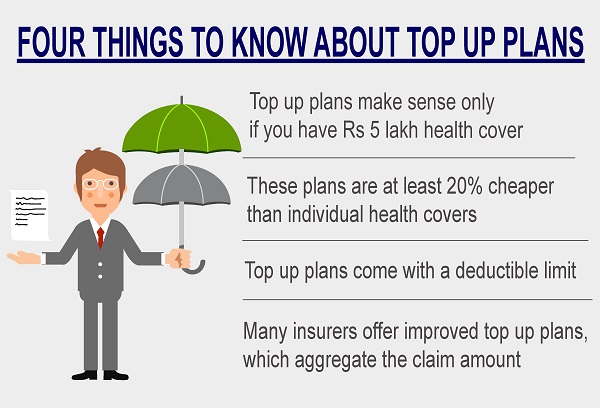
With medical inflation growing in double digits, year after year, inevitably, hospitalisation expenses are also on the rise. In such an event, your health cover could fall short of medical expenses and burn a hole in your pocket. Hence, there is a need to review your health insurance and cover any shortfall. In such a scenario, it makes sense to go for a top-up plan as they are at least 20% cheaper than going for a new health cover altogether.

What is a top-up plan?

It is a regular indemnity plan that covers hospitalisation costs only after a certain threshold limit, which is called a deductible in insurance parlance. One portion of the claim is borne either by the policyholder or the other insurer. Once the policyholder pays off that component, the top-up health cover kicks in.

Let’s assume you have taken a top-up plan of Rs 10 lakhs and it has a deductible limit of Rs 4 lakhs. If the total hospital bill comes to Rs 7 lakhs, you need to pay Rs 4 lakhs and the balance (Rs 3 lakhs) is paid from the top-up plan.

Why are top-up plans cheaper?

No, there are no caveats here. These plans are at least 20% cheaper than individual health covers, mainly on account of deductibles. These deductibles protect top-up plans from frequent claims. Hence, the insurers are able to keep the pricing of such plans lower.

When does it make sense to opt for a top-up plan?

Given the spiralling medical costs, a basic health cover of Rs 3 lakh to 5 lakh is not enough. A top-up plan is definitely a good way to bridge this shortfall. However, it’s not always the best option

  • If your base cover is high, say Rs 5 lakh or more, it makes sense to opt for a top-up plan
  • If your base cover is low, say Rs 3 lakhs or less, it’s better to opt for another individual health plan since top-up plans are mostly reimbursement plans

topupplanschanges1

Top-up plans: What’s available in the market?

There are two kinds of top-up plans available: a basic top-up plan and a floater plan.

Basic top-up plan:

The policyholder will get the benefit of a top-up plan only if the bill exceeds the deductible limit in a single event of hospitalisation. For instance, if an individual’s hospitalisation bill is Rs. 5 lakh and the top-up plan has a Rs. 3 lakh deductible, and the individual gets hospitalised twice in the year, the first time it costs Rs. 2.5 lakh and the second time Rs. 2 lakh, the top-up plan will not get triggered at all. The total bill overshoots the limit of Rs. 3 lakh; however, each event of hospitalisation is well within the deductible limit.

Floater plan:

With a floater plan where two members get hospitalised with bills of Rs. 2.5 lakh each, the top-up plan will not get triggered at all. Even though the total amount is more than Rs. 3 lakh, individually, they are within the deductible limit.

Aggregate claim:

This is an improvised version of the above-mentioned plans. This plan puts together several cases of hospitalisation to calculate the deductible limit. So if the total bill of all the events of hospitalisation crosses the deductible limit, the top-up plan will get activated.

Avoid these common money mistakes

Money Mistake Image

Investment is the postponement of consumption. We invest our money with the expectation that it will grow with time. Since money loses value over time due to inflation, it must generate returns higher than inflation to protect its value.  Investors make several mistakes in their investments that hamper the objective of their wealth creation. For instance, investors are overweight in one particular asset or don’t diversify their equity portfolio across the sector. Here we are delineating seven major investment mistakes frequently committed by investors.

Money lying idle in bank accounts

It is a well-known fact that no interest is paid in the current account, and savings bank accounts offer as little as 4% interest. The money lying idle in a bank account loses the opportunity to grow. So, if you want to see your money grow, invest it in some good profit-making schemes based on your financial goals. You can at least park your money in liquid funds or short-term fixed deposits, even if you do not want to invest for the long term.

Overspending on credit cards

It is very easy to overspend on credit cards, which is a bad practice. Make sure that you buy only what you need. Do not use credit cards, if you cannot pay the bill on or before the due date. Remember, rolling credit attracts a high interest rate.

Foreclosing SIPs

Buy low and sell high is the key to making a profit, but you cannot always time the market. Hence, SIP is the best way of investing in mutual funds, especially equity-oriented. The whole idea of investing through SIP is that your cost will average out in the long term.  It is commonly seen that people cancel their SIP when markets underperform temporarily, which is otherwise the best time to invest. Investing more units of mutual funds through SIP when markets underperform results in huge profits when the markets reach new heights.

Trading based on tips

Equity markets are the best place for investment, but you need access to research and patience to earn a profit from your investment. Over 5000 stocks are listed on the BSE, but not all stocks are worth investing. Traders who trade by following the tips given by their friends and colleagues lose the most. Invest in the equity market with the help of a professional for your long-term financial goals. Do not invest in the equity market based on short-term trends.

Excessive use of Margins

Margin means using borrowed money to purchase securities. Margin indeed helps you to make more money, but in case the market falls, your loss exceeds manifold and sometimes even beyond your imagination. New investors always make the mistake of considering this Margin as free money, and this is where they make the biggest mistake. Margin is not free money. If we invest the margin money in any stock and the stock does not perform according to our planning and expectations, we end up with way too much loss without any gain. Ask yourself whether you would like to use your credit card to buy stocks? I know your answer is ‘No’. Using Margin is similar to using your credit card for buying stocks. Refrain from doing so.

Buying stocks that appear cheap

It is a common mistake to buy cheap stocks. Traders often compare the current share value of any company with its 52 week’s highest value. They consider buying cheap stocks as a good buy. For them, buying the shares of a company that was priced 40% higher last year is a good bet, but they forget that the higher prices of the shares last year are not going to give any benefit to them this year. Instead of buying the shares restlessly, it is better to investigate the reasons why the share prices of the same company have fallen so low. It is advised that the traders should always keep a critical eye on the fallen value of any stock, as it may hint at any foul play in the market.

Favor for any specific company

It is natural for us to love any company that always gives us good returns. We try to invest again and again in the same company to reap maximum benefits. But sometimes, we forget that we have bought the shares of the company for investment purposes, and the only aim of buying these stocks is to make a profit and nothing else. So, if at any time, you feel that the stocks of that company are not performing well, you should instantly stop investing in the same company. At the same time, you should look for any other company that is performing better. Favoritism in investment is risky for any trader.

It is very common to err while making investments. But learning from those mistakes, and identifying when you are repeating those mistakes and how you can refrain from them, is the key to successful investment. To refrain from mistakes, you have to make an intellectual and systematic program. Whatever you do with your money is up to you, but keeping these advises in mind will definitely help you create wealth over a period of time.

Using credit cards? Subscribe to a card Protection Plan

credit cards 2

However organised we are in our lives, at one time or another, it happens that things get somewhat messy around us. Similarly, we try to keep our wallet organised and protected at all times, but sometimes we miss our plan. A wallet lost is something that most of the people experience, at least once in their lives. Sometimes back, losing a wallet just accounted for the loss of some money and bills for some expenses, but nowadays losing a wallet means loss of debit cards, credit cards, licenses, PAN cards and many other things. Our habit of keeping all of these together has increased the risk of losing them all together.

So what would you do in case you lose your debit card? I think the normal procedure followed by you will be to call each and every bank to block your missing card, and then you will apply to get the new one. This procedure is absolutely normal, except when you are pressed for time or if you are prone to panic, because this process takes some time to work. In such circumstances, card protection plans come to you as a saviour. Yes, these plans are really awesome and useful for us.

Many companies like CPP India, One Assist, etc., offer the best card protection plans. If you do not want to go directly with them, the card-issuing banks themselves offer card protection plans in association with these companies. You can avail any of these services at any time you want.

How does a card protection plan work?

To use any card protection plan, what you need first is to register yourself with the plan by paying the decided amount. After that, you will have to register the details of all your cards with the service provider company. The cards may include your PAN card, driving license, credit card, debit card, etc. There is no limit on the number of cards that you can register.

Benefits of Card Protection Plans:

Nobody will subscribe to something until they see some benefits in it. Here, I am enlisting some benefits of card protection plans, which make it worth subscribing.

  1. The first and foremost benefit of a card protection plan is that, in case you lose any of your registered cards, you can call the service provider to apprise them about the loss, and the service provider will in turn, set about blocking of all those cards for you. Not only will they help you in blocking your lost cards, but they will also help you to get them replaced.
  2. In case of loss, some of these service providers replace your PAN card for free. Some companies even replace your driving license, free of charge.
  3. Although, there is some limit applied, these providers give some sure protection against the fraudulent transactions made with your card. For e.g. CPP India 1399 plan, which is also called the Classic plan, offers protection against fraud of up to Rs. 1 lakh. HDFC bank gives of a fraud cover of up to Rs. 2.5 lakh.
  4. These companies give you 24*7 protections against skimming, PIN fraud, ATM fraud, and phishing, which are very common types of fraud these days.
  5. In most of the plans, the protection period begins at least a week before the report of card loss is filed. Some companies even offer a grace period of 30 days to their customers. It gives you plenty of time to report and gives you protection as well.
  6. Most of these plans offer emergency services like emergency cash advance, ticket replacement service, settling of hotel bills, etc., if any need arises. If you are travelling and you lose your card, you can use any of these emergency services and relax. However, the amount of money given depends on the type of plan you have chosen, or whether you are in the country or abroad. For e.g. CPP India Premium Plan provides a cash assistance of up to Rs. 1.2 lakh, if you are overseas; and Rs. 20,000, if you are in the country.
  7. If you ever happen to lose your SIM card or phone, you can block it by calling these protection providers. Companies like OneAssist also help you to store your documents with them.
  8. You can even enrol your family member to avail the services of these protectors. For this, most of the companies provide Premium Card Protection services to their customer. By opting for that service, one can enroll for his/her spouse under the same scheme. If you wish to enrol more members, you can ask your service providers, and they will assist you with this. For the family members, you will get a good off on your opted scheme.

When to enrol for such card protection services?

This service is of no use to you if you carry only a single card with you and no more. But if you happen to use many cards, issued by different banks, or if you carry a lot of cards and documents with you and travel frequently, this plan is a must for you. This plan saves you from calling bank after bank in case you lose your wallet. If you are pressed for time, these plans are a boon.

Most of these plans have a span of 1 year. You can opt for the option of automatic renewal if you feel like renewing it after a year. These card protection service providers give you the maximum protection in case your cards are lost, but if your card gets misused by using the PIN or password authorisation, it will not be covered under the card protection plan provided by these agencies.

SIP, STP and SWP explained

SIP STP SWPimage

While we earn, investments are one of the major concerns. We all expect to get the best out of our investments. It is these investments that eventually help us build our dreams. While we make direct investments in shares and securities, there are huge risks involved along with a requirement for extensive market research. Thus, mutual funds have always been the best in terms of risk and returns. One can invest in mutual funds through numerous plans, such as Systematic Investment Plans and Systematic Transfer Plans, in addition to lump-sum investments. As we invest in installments through SIP and STP, we also have the choice to withdraw through Systematic Withdrawal Plan or SWP. Let us understand how these methods work.

Systematic Investment Plans

Under this method, one invests a fixed amount in a mutual fund scheme regularly on a particular date of every month. The benefit of investing through SIP is that one does not have to time the market. There are consistent deposits that lead to investing in the high as well as the low market that help you make the best out of the overall opportunities that were not easy to predict in advance. The investors are required to submit a one-time request for regular investment in the particular scheme of the mutual fund.

Several advantages one has while investing through the SIP. The essential benefit is having a dedicated and focused approach towards investment. Though there is a tremendous enthusiasm when people enter into the investment markets but fail to make regular investments. However, this plan reduces the burden later on as there is a predefined condition of investing a specific amount every month. So, one achieves an investment discipline. Also, one enjoys investment convenience. Another big advantage is rupee cost averaging. Because you get more units when market is down and lesser units when market is up, it helps to overcome risk of volatility and helps you generating better returns in long term.

So, the SIP system works where you have money in your bank account, and every month a fixed sum is transferred from your bank to the mutual funds.

Systematic Transfer Plans

The STP is a plan where one invests a lump sum amount in a particular scheme, mostly a liquid or money market fund and then transfer a particular amount to some other scheme in a predetermined interval. While the markets being very volatile and you do not want to take a risk with your money in the short term, you can choose to invest in equity mutual funds through systematic transfer plans. Thus, under the volatile market situations, investing in the STP scheme is better as you purchase units of equity funds in staggered manner and at also earn some returnson the balance amount in the liquid fund, where you park your moneyinitially.

Though returns from liquid funds are not very attractive, however you can expect better than what you receive from your saving bank account. Because a specified amount is transferred to the equity fund at a particular interval regularly, it helps in averaging the costs of investors.

So, The STP system involves investing a whole sum of money in mutual funds, mostly a liquid fund and selling some units of the same to further investing in equity mutual funds.

Systematic Withdrawal Plan

One can plan regular monthly incomes through the Systematic Withdrawal Plans. As per your requirement, you can choose to withdraw monthly as well as on quarterly basis. One usually opts for this plan to get a regular income after retirement to maintain cash-flow.

The SWP system works where you want to withdraw a fixed amount of money monthly or quarterly from your mutual funds to your bank account. It is exactly opposite of SIP.

Each opportunity has its own benefits. As per one’s objective and circumstances, one can choose the best option and get the best out of their earning to build their dreams better.

Avoid overspending during the holidays

Vacation planning Apr 29 2026 01 40 16 PM

With the holiday season ringing in, there is fun, frolic, and just so much enthusiasm in the air! While merry making is bound to be the theme of the season, it carries with it its own set of financial potholes to watch out for. The demanded shopping errands, the personal and professional gifting norms, as well as the family gateways – all come with a price that, though seemingly little, often pile up to burn a huge hole in your pockets at the end. To protect your bank balance from slipping beyond the limits you may like, we have curated a list of pointers that can help avoid the anticipated overspending for the holiday season:

Have a well-defined budget

Although the family get-togethers and thrilling parties are bound to overwhelm you, they often get you spending beyond control. To prevent yourself from a financial blunder, start off with a well- defined budget for the holiday period. You can outline an overall spending limit and further break that into heads/sub-heads as per your specifications, defining an upper limit for each such category. While you pen down this budget, make sure you have equal needs in place to help you implement the same.

Contemplate, Compare, and Curb

If you plan to spend the days off in a town or country other than your own, it is best to keep three keywords in mind: Contemplate, Compare, and Curb. Firstly, you must contemplate your holiday travels well in advance to bag a good deal within your budget. Secondly, you must vouch for a quick comparative analysis that encompasses destinations, routes, means of travel, and lodging and dining alternatives. Websites, such as makemytrip.com and trivago.in, help you discover hotels within your budget with all the available discounted fares. Lastly, curb unnecessary expenses on the trip as far as possible. This can mean anything from eating at largely lavish restaurants to shopping for souvenirs beyond requirements.

Choose wiser payment options

While those long shopping lists can make you want to guiltlessly swipe the credit cards, it is sure to haunt you back at the end of the month with an equally long bill. To keep a tab on the money that goes out, make sure you pay the bills by debit card instead. Not only will this help you save the substantial interest you pay on credit, but it also protects you from spending more than you can afford to. Furthermore, avoid using credit cards at all costs if you do not expect strong cash flows to counter the bill before the due date.

Consider cheaper travel modes

If traveling out of town, it is wise to plan and book tickets in advance to avoid unnecessary hassles at the last moment. While all of us would want to cut out the long travel time and opt for air travel, considering the otherwise mandatory expenses that the holiday entails, it is best to travel via trains, and especially so if it’s only an overnight journey. Similarly, for smaller distances, you can also opt for steady bus services and Volvos.

Please your loved ones with homemade gifts

Not only do the holiday gifting trinkets come with an unnecessarily heavy price tag, but they are also often not customizable to your liking. Instead of gifting your loved ones formal, lackluster gifts, attempt to make easy mementos at home, such as handmade chocolates and cards. Apart from the praise they will garner from your dear ones, they are also bound to save you a substantial sum of money.

With these simple tips, you can certainly curb the otherwise solicited overspending for the holiday season, thus making sure that the festivities only bring in abundance and prosperity instead of making you rant out on your finances. After all, safe and secure spending is any day better than a sorry overspent state at the end!

How to measure the risk of your mutual fund portfolio

Measure the Risk Apr 29 2026 12 38 50 PM

You must have heard this line in all mutual fund advertisements. “Mutual fund investments are subject to market risks. Read all scheme-related documents carefully.” Then you may wonder why you should invest in mutual funds. The reason you are investing in mutual funds is that they invest in a diversified portfolio of shares and securities. Moreover, professional fund managers are managing your money, and you bear the fund management charges for that. Then, where does the risk come in?

Yes, investment in mutual funds is less risky than investing in direct stocks, but that doesn’t mean that mutual funds entail no risk. The very nature of investment instruments that your pool of money gets invested in is subject to periodic movements. Share prices change each minute, debentures are dependent on the yields and the papers available during a particular period and deposit rates change with the company and time. As a result, no mutual fund can promise returns that it will deliver. Nobody can precisely predict the market movements. So when share prices across the board are plunging, your equity-mutual-fund performance will be bleak, and when companies are faltering on deposit payments, the mutual fund scheme will suffer too. Though professional fund management ensures the reduction of stock-specific risk, there are several other risks that mutual fund schemes still have to deal with and here are three different ratios, which will help you measure the risk quotient of your portfolio.

1) Beta

It measures the volatility of a particular mutual fund in comparison to the market as a whole. A beta of 1.0 indicates that the NAV of the mutual fund will move in the same direction as that of the benchmark index. If the Nifty goes up, so will the NAV of the mutual fund that has the Nifty as its benchmark. Similarly, if the markets go into a tailspin, the NAV of the fund will also fall.  If the beta is less than 1.0 indicates that the fund’s NAV will be less volatile than the benchmark index. On the other hand, a beta of more than 1.0 indicates that the investment style of the mutual fund is aggressive and more volatile than the benchmark index. If you are an aggressive investor, you can opt for these funds as they move up more than the benchmark, but the fall will also be steeper. If you are a conservative investor and prefer low-risk investments, you should consider mutual fund schemes with low beta.

2) R-Squared

Beta cannot be considered as a standalone measure; it needs to be considered along with ‘R-squared’, which measures the correlation between beta and its benchmark index. The combination of these two statistical measures helps you understand the risk of a mutual fund more accurately. Typically, ‘R-squared’ values fall in the range between 0 and 1, where 0 represents no correlation, and 1 represents full correlation. The lower the R-squared, the less reliable the beta, and vice versa. In other words, the beta of a fund has to be trusted only if the R-squared value is between 0.75 and 1. If the R-squared value is less than 0.75, it indicates the beta is not particularly useful as the fund is being compared against an inappropriate benchmark index. This fund will not mirror the returns of its benchmark index.

R-squared of an index fund, which invests in the same securities and in the same weightage as the underlying benchmark index, will be one. Given that Beta and R-squared are calculated based on historical data, it makes sense to consider Beta and R-squared before investing.

3) Standard Deviation (SD)

Standard deviation measures the volatility of a mutual fund by showing how much the return on a fund deviates from the expected returns based on its historical performance. It computes the total risk, which includes market risk, security-specific risk and portfolio risk of a mutual fund.

In simple words, standard deviation tells you how consistent the performance of your mutual fund is over a period of time. The higher the SD, the higher the volatility of the net asset value (NAV) of the mutual fund and the riskier your investment. However, you should use SD only when you compare a mutual fund with its peer group mutual funds. For instance, you should compare the SD of a large-cap fund with another large-cap fund and not with a mid-cap or a small-cap fund.